Agile and CX

¿Are we prepared for the future?

Currently, a successful enterprise has the imperative need to anticipate the needs of its customers. To achieve this, it is a requirement to have the flexibility and rapid adaptation capabilities to react to the changes that are demanded.er capacidades de flexibilidad y adaptación rápida que permitan reaccionar a los cambios que se demanden.

Within this framework, agility in a company must be adopted as one of its main characteristics. This is the only way to develop customer experiences that are aligned with what the market is demanding at that moment. It is key to be constantly observing the environment and your customers, while reacting quickly and efficiently.

The importance of agility lies not only in responding to changing market and industry conditions, but also in transforming these moments of change into opportunities for growth. Therefore, a business culture oriented to agility and total transformation of the corporate approach is required.

Eva García-Luna, solutions consultant at Zendesk, in an interview with TechTarget mentions how to achieve an agile mindset in enterprises:

  • Make an integrated analysis: With no real time information on customer experience trends, it will be almost impossible to have an idea of where your enterprise needs to go.
  • Create standards and processes that drive collaboration and knowledge sharing, in order to adapt to new habits and position to scale and evolve in CX.
  • Use automation to reduce redundant tasks and the cost of change management, which means you will not have to train your agents for every change. This will allow you to evolve your operation and test new strategies.

In addition, the same interview mentions the three key elements required for Enterprise Agility:

  1. Facilitate customer listening: the majority (75%) of Latin American customers are more or much more likely to buy from an enterprise that offers good customer service, as well as different customer care channels, and this value is considerably higher than the world average (49%). However, many enterprises continue to miss valuable opportunities to listen to their customers in the channel in which they are. Only 34% of medium-sized enterprises offer three or more channels to their customers, and that figure drops to 32% for large enterprises.
  2. Consolidate teams that can remain productive in times of change: 88% of business leaders report that making changes in customer service is a challenge. To be prepared for an ever-changing landscape, enterprises are adopting agile and flexible frameworks for both technology adoption and implementation, which helps their support team work better. Improvements can positively impact employee engagement and thereby increase customer satisfaction. In addition, they will help in reducing costs through operational efficiency, and even increase revenues. These are benefits that will positively affect both the business and the customer experience.
  3. Invest in the right technology: When considering where to invest, technology is a great starting point. Providing a single unified workspace for your agents plays an important role in increasing team productivity. Moreover, it can help you get a better view of the customer; in fact, leading enterprises are 5.8 times more likely to say they provide agents with a unique view of the customer’s most important context.

In addition to this, the phrase “the customer is always right” is very much ingrained in our minds, but the ways in which this is accomplished tend to be in constant evolution, especially in recent years. Enterprises struggle to perfect and maximize their customer experience, which was intensified in 2020, and during 2021 has remained a constant that will not disappear.

As a result of COVID-19, it is clear to us that the enterprise-customer relationship has changed forever, but the CX areas have not reacted as quickly as the markets demanded. During 2021, many enterprises are correcting those pending gaps, seeking ways to correctly reach their customers remotely and through new communication channels in this fractured world.

In this context, there are tangible trends that are predicted for the future:

Centralize CX on a single management platform

CX management is complex and involves multiple areas within enterprises, so it is complex to survive and carry out this task by applying patches or keeping these areas separated. During the last time it has become clear how crucial it is to move towards the centralization of CX elements on a single platform.

Scott Harris, CEO of experience management enterprise Experience.com, told CustomerThink.com that, “As businesses become more sophisticated, they will demand a single, integrated CX platform that combines data, behavior and marketing from a single platform. Such enterprises will not have to pay millions of dollars for a consultant to build a customized program.” In the past, suitable platforms to do this were prohibitively expensive, however, during 2021 we will see prices reach a point where most enterprises will have no choice but to buy it.

Leveraging networking opportunities

The pandemic limited the one-to-one relationship with customers and left the digital means of contact as the protagonists. This, in addition to the trend of today’s consumers seeking to face your enterprise increasingly more informed, using multiple ways to access information about you; makes it essential to have a correct mapping of the channels in which you as an enterprise can be found; of the information they can access through those channels; and of the support generated by this in alignment with your value preposition. Enterprises must be prepared for these multichannel interactions and to connect properly with their customers wherever they are.

Active CX

The relationship with customers through CX is usually focused on guiding them through the enterprise, while customer acquisition is left to separate marketing and sales areas. This model is obsolete and needs to be updated. Nowadays, the CX must work actively to attract and retain customers, taking a step ahead from the traditional areas. This means that, in practice, the role must be much more active.  The future of the customer relationship will be driven by the ability to collect data about the experience, whenever and however it is happening, so that actions can be taken while the experiences are still ongoing.

Self-Service Optimization

Even though the importance of human connection cannot be overstated, there is something to be said for letting customers handle things the way they want to. According to Kate Crane, content marketing manager at Zendesk, 67% of customers prefer self-service over dealing with an employee.

Whichever self-service medium is chosen according to its channel, the approach in all of them must be to facilitate through sufficient and efficient infrastructure that the customer can be autonomous and respond to their service preferences. Efficiency will be the key for enterprises that expect to meet future challenges and customer demands, and there is no better way to respond to this than by providing true self-service alternatives so that these customers can do the work themselves.

Automation

Even the most refined customer service models have customer service agents as the main focus, and these agents are increasingly demanded and required for repetitive, systematic tasks, etc. Due to the fact that these agents will not disappear from the customer service ecosystem in the near future, automation systems must be devised to relieve the burden on them and enable more efficient use of their time and resources. This is the only way to ensure the proper quality of service in response to current high demands, focusing on high-value interactions and better distributing efforts.

All the trends and predictions mentioned above that interrelate Agility with CX correspond to the key focuses that your enterprise should work on or consider as part of its near-term strategies. Belltech, as experts in Digital Transformation, we can be the business partner you need to help you take these missing steps and properly prepare you for these new challenges and environments. Contact us and get the advice you need to overcome these challenges https://belltech.la/contactanos/.

BELLTECH ADDS NEW PARTNERSHIP WITH BRAZE

For the benefit of your customers

Braze, the integrated customer engagement platform arrives to Latin America through its new partnership with Belltech, offering the leading cross-channel solution based on the efficient use of data and combined with service excellence.

Driviing real-time, relevant and personalized customer experiences.

Nowadays, customers expect relevant, convenient, connected and personalized communication in every interaction, whether in person or through any other digital channel. Braze enables brands to build stronger relationships with customers by creating relevant and memorable multichannel experiences.

Braze helps brands empower real-time interactions with their customers in a customized way. It enables brands to develop a deep understanding of their customers’ preferences and deliver experiences that increase loyalty and retention.

In “The Total Economic Impact of Braze”, a study commissioned by Forrester Consulting, Braze clients have realized a ROI of *840% over 3 years. More than 1,000 brands across all industries rely on a solution like Braze to deliver the right message to the right person at the right time and on the right channel.

(*) “The Total Economic Impact of Braze,” a  commissioned study by Forrester Consulting.

Thanks to this partnership, Belltech completes its portfolio of solutions dedicated to improving the customer experience and seeks to be ranked in the region as the most robust service and integration enterprise in the market.

Since the beginning of the partnership agreement, Belltech has already entered the fast-food and payment methods markets in Chile and Brazil, respectively, incorporating important chains from these industries to our set of clients.

Michael Everard, CEO of Belltech comments, “Thinking about the difficult scenario that Latin America would be living this 2021, due to the political and social changes that have been building up, which also have been strongly influenced by the pandemic, in Belltech we began our search to incorporate to our portfolio an innovative, versatile and world-class solution that would allow different industries to automate and optimize their relationship with their customers. This will help businesses to carry out processes more efficiently and with less effort, and thus be able to create loyalty and profitability models with their customers.

Michael Everard, CEO of Belltech comments, “Thinking about the difficult scenario that Latin America would be living this 2021, due to the political and social changes that have been building up, which also have been strongly influenced by the pandemic, in Belltech we began our search to incorporate to our portfolio an innovative, versatile and world-class solution that would allow different industries to automate and optimize their relationship with their customers. This will help businesses to carry out processes more efficiently and with less effort, and thus be able to create loyalty and profitability models with their customers.

Through the Braze Platform offered by Belltech, enterprises will be able to: Easily create multi-channel campaigns with dynamic audiences and implement personalized journeys through an intuitive drag and drop interface. They will be able to leverage their investments through simple integrations using the best technology to amplify the value of their ecosystem and save on additional solutions. In addition, it will be possible to reduce technical maintenance hours, due to the fact that by using Braze they will save 1200 hours in maintenance and integration, which frees the teams to focus on business challenges.  Source: The Total Economic Impact Of Braze, a commissioned study by Forrester Consulting.

This is how you create powerful interactions with your customers! You drive engagement and increase transactions, recover lost customers, and stay in contact when they need you.


About Braze:

Braze is an integrated customer engagement platform that drives relevant and memorable experiences between customers and the brands they love.

Context is the foundation of all Braze interactions, helping brands foster a human connection with consumers through interactive conversations across all channels that deliver value quickly and continuously. Braze was recognized as one of the Best Places to Work by Fortune in 2021 in New York, the Best Workplace for Millennials by Fortune in 2021, and has been certified as a Great Place to Work in the United Kingdom and the United States. Braze is based in New York, and has offices in Chicago, London, San Francisco, Singapore and Tokyo.  More about Braze can be found at www.braze.com.

I WANT A VIRTUAL ASSISTANT!

Making service efficient and simple

When someone assists us, we expect them to be fast, efficient, simple and effective, especially when we need clear and specific information. Virtual assistants offer this, in addition to a wide range of other benefits for both the companies that implement them, as well as the users who interact with them. The great development of technology and its expansion to all types of users, has brought as a result advancements that have even led to the creation of devices made for personal use at home, such as the already known “Siri” from Apple, “Alexa” from Amazon, or “Cortana” from Microsoft.  That’s right, Virtual Assistants are no longer just the stuff of science fiction, movies or an out of reach solution, but have made their way into homes and technology users worldwide. On the other hand, virtual assistance software has expanded to those industries that seek to respond quickly and clearly to the requirements of their customers and thus improve the service experience they receive.

Belltech’s virtual assistants, beyond answering questions, are able to engage in a natural and intelligent conversation, regardless of the channel from which the conversation arises, always making sure of delivering a quality experience, without falling into redundancies or inconsistencies often associated with other similar solutions.

Virtual Assistants ensure Efficiency, Consistency and Business Focus

They have the technology and artificial intelligence to understand even the most complex queries in a natural tone, providing fast and efficient answers.

They guarantee quality and omnichannel using “Natural Language Understanding” (NLU) technology, which translates into a consistent response on all platforms where the Virtual Assistant and the client interact.

And finally, they ensure a business approach that safeguards security, reliability, and privacy of the stored data, always adapting to the requirements and characteristics sought by the customer according to their business strategy.

According to the “The future Customer Experience 5 essential trends” report, AI engines are the new intermediaries between businesses and customers in the purchase decision: “the complexities of modern life are driving our brains into cognitive overload. To deal with the situation, customers are turning to AI engines, trusting their recommendations and putting traditional brand interactions on the back burner.” People are increasingly relying on interaction with Bots, which are already becoming part of our lives.

The role of virtual assistants has been key in these times of pandemic crisis, offering quick solutions and avoiding physical contact through various service channels, such as social networks, telephone services, websites, among others. In addition to this, the level of trust that a user places in these customer service mechanisms has grown, and they are now a safe and efficient way to resolve customer problems and processes.

Virtual assistants are technological beings that learn and adjust themselves according to the type of response that is required. They incorporate a large number of variables in their communication style, such as using a colloquial language (for example, they can use “usted” in Colombia, “tú” in Chile or “vos” in Argentina); using a technical language; or adjusting to a certain tone and specific style, according to the needs of both the business and the customer, leading to brands being increasingly closer to their consumers.

If a response it’s not possible, or if the service requires the intervention of a real agent, assistants will generate the referral in real time and without affecting the service flow, while being transparent to the customer and maintaining the level of experience. Virtual assistants have values, identity and a purpose according to what the company wants to convey. They can be programmed specifically for the required industry or role, delivering unprecedented flexibility of action.

If you found this content interesting and want to know more about Virtual Assistants, at Belltech we will be happy to support your Digital Transformation projects, offering you the support and advice you need to carry out a solution like this.

We invite you to send us your information at www.belltech.la/contacto/ and an agent will contact you in less than 48 hours.

Banco Macro: Moving towards a complete digital experience for your customers

Banco Macro has incorporated into its Digital Transformation strategy a complete renovation of its virtual assistant “eMe”. This solution was born from the search for an omnichannel solution to digitize customer service that allows automation as the first point of contact and thus the overflow of digital contact center operators. The solution implemented by Belltech in partnership with Nuance Communications using Artificial Intelligence technology is called “Nina”.

This evolution of its virtual assistant allows the Bank to establish a more intuitive and more evolving conversation, using natural language, with its customers as the first point of contact through its digital channels (website, social networks, WhatsApp, Mobile, among others), thus optimizing its processes. In this way, the virtual assistant is positioned as the first frontier of customer service without detracting from the experience delivered, thus collaborating with the corporate vision that seeks to achieve Macro’s recognition as the leading bank in customer satisfaction in Argentina, and that guides its customers to know more so that they can make better decisions.

With this premise in mind, “eMe, de Macro” is programmed to answer all banking queries, and in case there is any question it cannot answer, it learns it. Thus, it transparently communicates its evolutionary capacity.

Alejandra Rodríguez,
Digital Transformation Manager, Macro.

Alejandra Rodríguez, Digital Transformation Manager at Banco Macro, details, “Among the main results observed after 4 months of implementation, there has been an improvement in the dialogue strategy of the Virtual Assistant “eMe”, making it a more fluid and humanized logic, capable of processing more than 135,000 monthly interactions through the different customer service channels and achieving a recognition rate of close to 90%.”

¿What process did Banco Macro go through to select this solution?

“We evaluated different solutions that met the business objectives. The Bank already had some previously implemented solutions, which were replaced. In this process, we studied several tools available in the market and finally, since Belltech has been a strategic partner of the Bank for several years, and Nuance has the technology and the solution that best suits our needs, we realized that our best option was to hand over the project to the Belltech-Nuance alliance“, adds Alejandra.

The Bank incorporated the Nuance “NDEP” (Nuance Digital Enterprise Platform) suite, which allows the development of Virtual Assistants in different Digital Channels, such as Web, Mobile, Whatsapp, Facebook, Instagram, among others. This solution implemented by Belltech includes a Live Chat, giving the possibility to integrate the overflow to digital operators and a functionality called “Nina Coach”. Said functionality optimizes the handling of interpretation intents, thus improving the user experience in the use of NLU natural language, which was one of the main challenges in the development of this strategy.


About Banco Macro: It currently has 8,706 employees, 1,547 ATMs, 957 self-service terminals and a structure of 500 points of service. It is currently the private bank with the largest network of branches throughout Argentina, and thus is positioned as the number bank of the National Private Capital Banks.

KEY DIGITAL TRENDS FOR POST PANDEMIC RETAIL

4 trends in technological solutions

The technological industry is in a deep phase of interaction since the beginning of the pandemic, in which businesses dedicated to the end customer seek to provide solutions to their demands, whether in terms of service excellence, shipping logistics, quick response to the search for products or services, among others. We can talk about a myriad of customer service solutions, among which we highlight the following: self-service solutions such as self-checkouts and kiosks; solutions to automate customer service such as virtual assistants, AIs, conversational IVRs, recording systems, VOC, RPA; and finally, solutions for analytics and prediction through data, such as predictive monitoring, big data, etc.

Employing the combination of these technologies, we are seeking to improve interaction with the end consumer and make the points of contact more profitable.

In this sense, despite the boom in digital innovations, we cannot ignore that the customer still privileges the fact of being able to look, touch, compare, smell and try products; experiences that cannot be replaced with the purchase process through a screen.

The enormous number of sales that are transacted today in e-commerce, social networks, applications, in addition to the information provided for dispatches, provide a great amount of information about the consumers, their behavior, tastes, flows and willingness to buy. Therefore, through the use of Data Mining/Big Data, we can predict actions, average ticket, and preferences, in order to improve the business performance towards its customers.

Renewal in terms of digital trends is, therefore, a must for current companies for establishing a successful future.

Below, we present 4 digital trends that we consider as essential and key for this post-pandemic technological evolution:

Experience stores: to understand this concept, Retail Analytics explain it like this: “in simple words, the retail experience or experience stores consists of the customer’s experience from the moment they arrive at the store and observe its façade, to every step they take inside, which will generate positive or negative opinions that will be decisive when deciding to return and that will also be transmitted to friends and family.” For example, large supermarkets already have mostly self-service checkouts, experiences that help to build loyalty among customers who are looking for autonomy both in their shopping and in their time management, seeking to obtain an increasingly better customer experience; as well as providing great fluidity and speed during the shopping interaction.

One of the changes that has made the greatest impact is the multichannel approach. According to Telefónica’s digital blog “The think Big”, “the technological tsunami has radically changed the way consumers relate to brands. One of the changes that has made the greatest impact is multichannel. In the retail sector, the point of sale is competing more and more with ecommerce, mcommerce and social networks”.

Unified commerce: one of the great challenges facing Retail is the convergence between the physical and the virtual, namely, Phygital, which according to the same article we published in April, it’s one of the latest trends in UX. It unifies a person’s experience in both a physical and digital environment, the elevation of two worlds that today is present in commercial transactions more than ever, driven by social and economic factors and empowered by behavioral change in the wake of the global pandemic.

Big Data in Store: thanks to technological advances, it is now possible to store and analyze an unimaginable amount of data, generating historical evidence, trend prediction, frequency visibility. This allows businesses to generate strategic plans for customer service, along with greater effectiveness and efficiency of points of sale, both online and offline, and a more efficient management of their customer service flows.

Robots: they help in the purchase, the user service, the checkout, in problem resolution, and relieve executives’ service channels in order to redistribute service more efficiently. Rather than replacing humans, (a concept we also discussed in one of our previous posts), this technology comes to support, leaving tasks of analysis and greater cognitive complexity to us, thus building a robust customer service team.

In short, digital evolution is paramount and is not an option, especially considering the changes in the industry that are driven by diverse factors.

Even though we presented 4 trends here, there are undoubtedly many more. It all depends on how strategic you want to be, the solutions you want to provide, and the story you want to tell. In Belltech, we support you during the process, we adapt to your requirements and fit our technologies to your goals. We are a company that supports and advises you in your transformation and technological development projects.

IT IS RPA TIME

Fast and efficient solutions demand automation combined with human analysis.

Now is the time for automation and human functions to come together to meet new market demands. We try hard to find quick solutions to processes that for us as clients seem so simple, but the organizational response shows us that, due to lack of employees or administrative management, the requests cannot be processed the way we want them to be: fast and efficient.

As Belltech, we see that many repetitive processes within organizations would be more efficient if RPA were incorporated into them, but we understand that enterprises do not always make the leap to this evolution, because they’re afraid of the costs, the complexity of new processes, the belief of complex implementations, among others. But let’s understand RPA in simple words, what it promises to come to solve, and why it is so urgent to incorporate it today.

Robotic Process Automation (RPA) is a digital solution that helps us to create virtual robots to automate repetitive tasks in organizations. RPA is capable of automating processes as simple as a copy and paste activity, up to tasks as complex as detecting fraud or unpaid bills. Basically, it depends on how clear the organization is about its procedures and the effective detection of those where cognitive analysis is not required to carry them out. From there, anything is possible!

Automation brings several benefits. Among them, for example, we notice how employees optimize their time to take care of truly essential tasks, demonstrating skills in data analysis. They afterwards transform these pieces of data into solutions, which leads to an effective use of service times in the peak hours, prioritizing better human interaction and customer experience. On the customer side, a better, faster, more efficient and error-free service is obtained. In addition, organizations improve compliance, can adapt their strategies to the demand peak and obtain insights according to the data collected by the robots. This last element is one of the most valued nowadays, as it allows to make visible information that was previously hidden behind the processes and increase the knowledge of their customers. And finally, the inclusion of RPA allows organizations to reduce costs and have a quick ROI, by efficiently allocating company resources to processes and data processing and improving customer satisfaction by delivering a quality service on time.

In summary, RPA technology helps organizations to run more efficiently!

Belltech, a company present in 7 Latin American countries and with more than 22 years of experience supporting the transformation processes of enterprises, can become the strategic partner that designs and executes the adoption of this technology within organizations. From a consulting point of view and offering full support during the process, we collaborate with our customers to ensure the success of the projects, and we use our experience to get the most out of the information for the knowledge of your final customer.

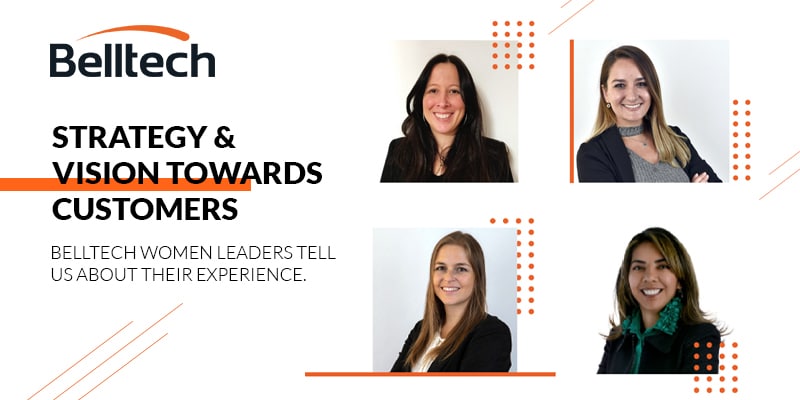
Strategy and vision towards customers

Strategy and vision towards customers

BELLTECH WOMEN LEADERS TELL US ABOUT THEIR EXPERIENCE.

These are the last days of March and Belltech wishes to end this Women’s month by commemorating this date showcasing its female leaders who have driven growth in the business and commercial planning area of the company. 

On this occasion, we invited Dayana Villalón, Marta Serna, Natalia Armand Pilón and Alejandra Günsche, leaders in the HR, Business and Marketing areas, to tell us about their experience and professional vision within the technology industry, as well as how being a woman has been far from being a negative differentiating element, and has been, on the contrary, a value within the company.

We asked them about the value of women in the area of Business and Commercial Strategy within companies. Dayana Villalón said: “working together with my colleagues has been very enriching. In my role in the HR area, it is important to empower fellow leaders and develop their soft and emotional skills”. In addition, Marta Serna tells us that she has not experienced any gender stereotypes during her professional career “…despite the negative figures in terms of female participation in Latin countries”. She points out that her contribution, just like any other employee’s, it’s based on her personal and professional experience. She has been working in the technology market for 28 years in different roles, which has allowed her to experience business situations from various perspectives. All of them are part of her experience and contribution to the business and strategies of Belltech.

Natalia Armand Pilón adds that: “in a dynamic world that evolves every day and where not only technology is important, but also empathy, I believe that women contribute to companies in general, whether they are from the technology industry or not. Businesses that understand diversity has benefits for the organization achieve greater progress, and I am not saying this myself. There is a lot of research and studies that prove it, and this does not only imply that there is parity in the number of men and women; I am referring to women who are part of the decision making, of the definition of the processes. Belltech in particular is a company that values talent more than gender, and I can say that based on my own experience. What the female presence brings is the ability to empathize, to have a different view, the ability to be in several areas at the same time, and the sensitivity for dealing with particular issues. In terms of negotiation, women go through more stages before closing a deal, I am convinced, and the question concludes, that organizations that understand the value of diversity have tangible increases in productivity, innovation and strengthening of team dynamics. In terms of negotiation, I’m convinced that women go through more stages before closing a deal. So, to summarize, organizations that understand the value of diversity have tangible increases in productivity, innovation and strengthening of team dynamics. Alejandra Günsche concludes: “from a team and management perspective, I believe that we have also been able to contribute to the search for multidisciplinary relationships, by encouraging work with all areas of the company, listening to different positions, points of view, and building consensus strategies without losing sight of the customer. In this way, we have built an area that broke down the base and grew through the value of collaboration”.

Dayana adds that according to Chilean Association of Information Technology Companies (ACTI, according to its acronym in Spanish), “in Chile there is only 5% female participation in IT, and worldwide, according to UNESCO studies on the education of girls and women in STEM (Science – Technology – Engineering and Mathematics), only 35% of students enrolled in these areas of study are women”.

This, in her opinion, “is related to the stereotypes that are still deeply rooted in our Latin American culture”, and she concludes by saying that “many of the jobs of the future that will be incorporated as a result of technological advances will require people that work motivated by objectives and that can mix both technical skills and soft skills. That is why women, who will obviously be part of this transformation as well as men, cannot be left out and will have many possibilities to be successful in these new roles”.

Alejandra shares her vision on the contribution of women in the technology industry: “I am convinced that the complementary thinking structures and skills possessed by men and women are an element of value within enterprises, making it possible to form high-performance teams regardless of the gender of the collaborator. In the technology world in particular, the inclusion of visions from different perspectives will only help to generate more creative processes, to better represent users, and understand the consumer in a better way. By analyzing all the possibilities, we are moving away from gender biases and towards a vision based on professional capabilities”.

Belltech, in this sense, has been incorporating concrete actions and hiring policies that promote gender equity within an industry that has historically been dominated by men. As a result, currently 19% of the company’s payroll is made up of women, of whom one third occupy senior positions within the company.

“…Nowadays we have seen that there are areas with equal numbers of men and women or even a female majority… On the other hand, there are countries in which we have recruited women for the technical area with excellent results, such as Colombia and Uruguay. As part of the process, we measure the personal skills and technical knowledge of the candidate, leaving completely aside whether they are a man or a woman, and we evaluate their fit with our values and their commitment to Belltech. We have equal pay policies, and we developed our salary scales by comparing the same positions in different high-tech companies. Among our values is Respect, as we promote and encourage collaboration, respecting and appreciating the diversity of our team. Our success is based on our teamwork, and thus we achieve common goals. This is where we at Belltech declare our interest in promoting not only diversity, but also inclusion, concepts that go far beyond being a man or a woman”, explains Dayana.

We also asked Marta and Natalia about the main challenges they had had to face in their professional careers, and both told us that they had not experienced great difficulties just because they are women, but rather due to some emotional vicissitudes or external factors. Marta explains that “breaking the glass ceiling”, which are the invisible barriers that must be overcome to ascend to high positions when someone is a woman, is, so to speak, the only impediment she has encountered to achieve her goals and successes so far, with constant and persistent work, ethics, honesty and planning.  Meanwhile, for Natalia, adapting to change is one of the main challenges, “…the speed of technological advances in business models and business paradigms forces you to be in a constant learning mode.” She also tells us about an article she recently read in the New York Times, which said “the speed of technology runs over our brains” …  “thus, artificial intelligence, ML, quantum computing, IOT, blockchain, Business Intelligence, are terms that 5 or 10 years ago seemed only theoretical models and today are a reality present in our daily lives, from deciding the route we will take to go to the office every morning with our smartphones, and the e-commerce shopping catalogs, to the lighting in our cities”. Another challenge is to understand the change in consumers. Today they are more informed, they ask more specific questions, and we must have an omnichannel approach to be able to bring the information to the consumer. Finally, the challenge of achieving a balance between personal and professional life is fundamental. The impact of motherhood on the professional career is a very important factor. Fortunately, more and more companies are creating conditions to reduce these impacts, and understand how important it is for women to achieve a balance between both roles.”

Regarding the challenges we talked about, since the opening of Belltech towards the incorporation of women in the area of technology industry, we asked Marta and Natalia how they perceive the growth and intervention of women in leadership areas in the technology sector. Marta emphasizes that gender equity is an issue that is increasingly addressed in all areas. “When we ask someone to mention leaders in the world of technology, we hear names such as Bill Gates, Steve Jobs or Mark Zuckerberg, for example, and we do not hear about Ada Lovelace, who created the first computer program, or Hedy Lamar, co-inventor of WIFI, so we still have a lot to develop and position”. Natalia adds: “the empowerment of women and girls will contribute decisively to progress, so it is essential to support and expand the involvement of women in leadership areas in all types of companies, specifically in the technology sector, which will undoubtedly contribute to generating simpler, more humane and empathetic organizations.”

To conclude this interview, we asked all our leaders to give some advice for the new generations that are beginning to make their way into the world of work, specifically into the area of Technology and Science. Alejandra’s recommendation is that: ”passion and dreaming big are key elements, as well as maintaining determination towards the objective; never taking the dedication factor out of the equation; and finally, living the process to the fullest, by learning from mistakes and enjoying every step forward”. Meanwhile, Marta reminds us of a famous ’80s movie called “Fame”, and draws an analogy between both situations, saying that the message would be: “fame costs’ and if you are really passionate about the world of technology, you must study, learn, and practice persistently, because in the end, the play will be a success”.

Natalia, who also points to the same key elements as Alejandra, namely dreaming and being passionate about work, urges them to go ahead and investigate, specialize and be curious. Natalia adds that: “… it is important to specialize because there are more and more robots that are going to do routine and repetitive jobs, or jobs that provide little value, so it is crucial to learn to do something niche.” “…we should always have an accepting attitude towards technology, so be prepared for constant evolution; and specifically, to women, I would like to say that they don’t have to be perfect, they have to be happy”.

To conclude, Dayana’s recommendation is to ”trust in your skills. This industry is extremely interesting, innovative and is growing by leaps and bounds, therefore, success will not be possible if we do not all work collaboratively”.